
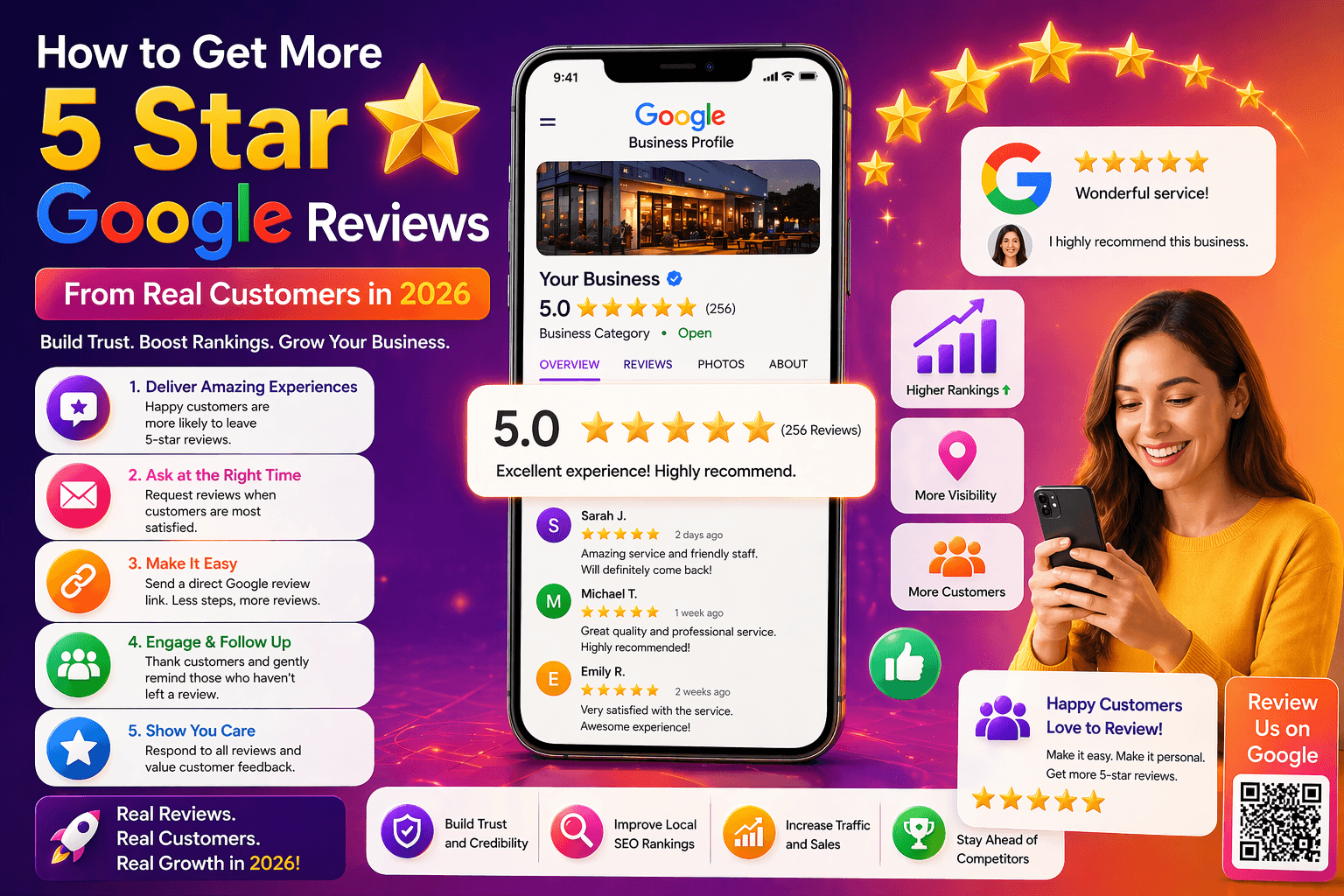
Your customers are your most powerful marketing asset — and their honest opinions, shared publicly on Google, are worth more than any advertisement you could ever run.
In 2026, Google reviews from real customers are the single most trusted form of social proof available to local businesses. They influence where your business ranks in local search, how many people click on your listing, and ultimately how many customers walk through your door or land on your website.
But here is the challenge most business owners face: satisfied customers rarely think to leave a review on their own. They have their own lives, their own schedules, and their positive experience with your business fades from memory faster than you might expect.
The solution is not to purchase fake reviews or game the system. The solution is to build a systematic, proactive approach to collecting genuine 5 star reviews from the real customers who are already happy with your business — the customers who would gladly leave a review if only they were asked in the right way, at the right time.
This complete guide gives you everything you need to build that system in 2026.
Why 5 Star Google Reviews from Real Customers Matter
Before diving into strategy, it is worth understanding exactly why real customer reviews are so valuable — and why genuine reviews outperform any shortcut in the long run.
They Build Authentic Trust
Consumers in 2026 are highly sophisticated at detecting inauthentic content. A Google Business Profile filled with generic, vague reviews from accounts with no profile photos or review history looks suspicious — and suspicious profiles lose customers rather than gaining them. Real reviews from real people, with specific details about their experience, build the kind of deep trust that converts browsers into buyers.
They Drive Local Search Rankings
Google’s local search algorithm uses review signals as a major ranking factor — accounting for approximately 17% of Local Pack ranking influence according to Whitespark’s 2025 Local Ranking Factors report. But critically, Google also evaluates the authenticity and quality of reviews, not just quantity. Genuine reviews from real, active Google accounts carry significantly more ranking weight than low-quality inauthentic ones.
They Create a Self-Sustaining Growth Cycle
Here is the powerful truth about real reviews: when your business ranks higher because of strong genuine reviews, more customers find you. More customers mean more experiences. More experiences mean more opportunities to collect new reviews. This creates a compounding flywheel effect that grows your reputation automatically over time.
They Protect Your Business Long-Term
Fake reviews can be removed by Google at any time, leaving you back at zero. Real reviews from genuine customers are permanent, resilient, and protected. Building your reputation on authentic customer feedback is the only strategy that reliably delivers lasting results.
The Psychology of Why Customers Leave Reviews
Understanding why customers leave reviews — and why they do not — is the foundation of any effective review generation strategy.
Research consistently shows that customers leave reviews for one of four main reasons:
1. They had an exceptional experience — Something genuinely surprised or delighted them beyond their expectations.
2. They had a very negative experience — Frustration and disappointment are powerful motivators. This is why negative reviews are so common without prompting — unhappy customers feel compelled to warn others.
3. They were directly asked by someone they respect — A personal, sincere request from a staff member or the business owner carries enormous weight. People want to help businesses they like.
4. The process was made extremely easy for them — Convenience is everything. If leaving a review requires more than 30 seconds and two taps, most satisfied customers will abandon the process.
Your review generation strategy must work with all four of these psychological drivers simultaneously. Make the experience exceptional, ask sincerely, and make it effortless.
Step 1 — Deliver an Experience Worth Reviewing
No review generation strategy can substitute for genuine quality. The foundation of every 5 star review is a 5 star experience.
This means going beyond simply meeting customer expectations — it means finding specific moments in your customer journey where you can exceed those expectations in small but memorable ways.
Ask yourself these questions about your current customer experience:
- Is your first point of contact — phone, website, or in-person — warm, professional, and welcoming?
- Do customers feel genuinely valued during their interaction, or simply processed?
- Do you follow up after a purchase or service to ensure satisfaction?
- Are problems and complaints resolved quickly, generously, and without argument?
- Is there a moment in your service process that customers consistently mention as memorable?
The answers to these questions reveal where your experience can be elevated. Even small improvements — a handwritten thank-you note, a follow-up call three days after service, an unexpected complimentary upgrade — can transform a satisfied customer into an enthusiastic reviewer.
Step 2 — Build Your Google Review Link
The single biggest barrier between a satisfied customer and a published review is friction. Every extra step in the process reduces the number of people who complete it.
Your Google Review link is a direct URL that takes customers straight to your review form — no searching, no clicking through multiple pages. Setting this up takes five minutes and dramatically increases review completion rates.
How to create your Google Review link:
- Log in to your Google Business Profile at business.google.com
- Click on “Ask for reviews” in your dashboard
- Copy the short review link Google generates for your listing
- Use a URL shortener like Bitly to create an even simpler link
- Save this link — you will use it across every review request channel
Once you have your link, make it accessible everywhere:
- Email signatures
- SMS and WhatsApp messages
- Printed cards and receipts
- QR codes displayed in your location
- Your website’s footer and contact page
Social media profiles and posts
Step 3 — Ask at the Perfect Moment
Timing is everything in review generation. The ideal moment to ask for a review is when customer satisfaction is at its absolute peak — immediately after a positive interaction, a successful delivery, or a resolved issue.
The best moments to ask for a review include:
Right after service completion — When a job is done and the customer expresses satisfaction, that is your moment. A simple, confident ask — “We really appreciate your business. Would you mind leaving us a quick Google review? It makes a huge difference for us” — is remarkably effective when delivered sincerely at the right moment.
After a compliment — When a customer says “I love what you did” or “That was amazing” — that is the perfect natural transition to a review request. “That means so much to us — would you be willing to share that on Google? It helps other customers find us.”
Following successful complaint resolution — A customer whose problem was solved quickly and generously is often more loyal and enthusiastic than a customer who never had an issue. After resolving a complaint, follow up personally and ask for a review. Many of your most detailed, positive reviews will come from these situations.
The day after delivery or installation — For businesses that deliver products or complete installations, a next-day follow-up message checking satisfaction and including a review link is highly effective.
Step 4 — Train Your Team to Ask Consistently
Individual staff members are often your most powerful review generation tool — and also your most underutilized one. Customer-facing team members who build genuine rapport with customers are perfectly positioned to make review requests feel natural and personal rather than transactional.
Implement a simple team training process:
Create a standard script that staff members can adapt in their own natural voice. For example:
“Thank you so much for choosing us today — it was genuinely a pleasure. If you have a moment, we would really love it if you left us a Google review. It helps small businesses like ours enormously, and it only takes about a minute.”
Then make it measurable. Track how many reviews are received weekly and celebrate when the team reaches milestones. When staff understand that their personal interactions directly contribute to the business’s online reputation, they become invested in the outcome.
Step 5 — Use Email Follow-Ups Strategically
Email remains one of the highest-converting review request channels in 2026. A well-crafted follow-up email sent within 24 to 48 hours of a purchase or service can yield response rates of 15 to 25% — far higher than passive review solicitation methods.
Elements of a high-converting review request email:
Subject line — Keep it personal and simple. “How did we do, [First Name]?” or “A quick question about your recent visit” consistently outperform generic subject lines.
Opening line — Reference the specific service or product. “Thank you for choosing us for your [specific service] last [day]” shows you remember them as an individual, not just a transaction.
The ask — Be direct and honest. “We work hard to give every customer a great experience, and your feedback means the world to us. Would you take 60 seconds to leave us a Google review?”
The link — Include your Google Review link as a large, clearly visible button. Never make readers search for it.
Closing — Keep it warm and genuine. Avoid corporate language. Sign with a real name — ideally the owner or the staff member who served them.
Email timing schedule:
- First email: 24–48 hours after service
- Reminder email (if no review): 5–7 days later
- Never send more than two review request emails per transaction
Step 6 — Leverage SMS and WhatsApp for Higher Open Rates
In 2026, SMS and WhatsApp messages have significantly higher open rates than email — typically 95% or above compared to 20–30% for email. For businesses that collect customer phone numbers, text-based review requests are extremely effective.
Sample SMS review request:
“Hi [Name], thank you for visiting [Business Name] today! We hope everything was perfect. If you have 60 seconds, we would love a Google review — it helps us so much: [your review link]. Thank you! — [Your Name]” Keep SMS messages short, personal, and include the direct link. Always ensure you have permission to contact customers via SMS before sending.
Step 7 — Create In-Location Review Prompts
For businesses with physical locations — restaurants, salons, clinics, retail shops, gyms — in-location prompts are a highly effective passive review generation tool.
QR code cards and signs — Place a small card or countertop sign with your Google Review QR code at the checkout counter, reception desk, or table. The sign should include a simple, warm message: “Loved your experience? Tell Google! Scan to leave a review.”
Printed receipts — Add your Google Review link or QR code to the bottom of every printed receipt with a brief message.
Wi-Fi landing page — If your location offers free Wi-Fi, configure the login landing page to include a review request and your Google Review link.
Thank-you packaging — If you ship products, include a small card in the packaging with a review request and QR code.
Step 8 — Respond to Every Single Review
Responding to reviews — both positive and negative — is one of the most powerful and underutilized tools in local reputation management.
Why responses matter:
- Google considers owner response rate as an engagement signal in local ranking
- Responses show potential customers that you are attentive and professional
- Responses to positive reviews make reviewers feel appreciated and encourage others to follow
- Professional responses to negative reviews can neutralize damage and demonstrate your commitment to customer satisfaction
Best practices for responding to positive reviews:
- Thank the reviewer by first name
- Reference something specific from their review
- Include your business name and one relevant keyword naturally
- Keep it warm, genuine, and brief (two to four sentences)
Best practices for responding to negative reviews:
- Respond within 24 hours
- Acknowledge the experience without being defensive
- Apologize sincerely for the disappointment
- Offer a specific resolution or invite them to contact you directly
- Never argue or escalate publicly
Step 9 — Make Reviews Part of Your Business Culture
The most successful review generation programs are not campaigns — they are cultures. When collecting customer feedback becomes a natural, daily habit embedded in how your entire team operates, the results compound over time in a way that no one-time campaign can match.
Practical ways to embed reviews into your culture:
- Share new positive reviews with your team every week — celebrate them
- Display your Google review count and rating prominently in your workspace
- Set monthly review targets and track progress publicly
- Recognize and reward staff members whose customer interactions generate reviews
- Include review generation in the onboarding training for every new team member
Step 10 — Monitor, Analyze, and Improve Continuously
Review generation is not a set-and-forget activity. It requires consistent monitoring and continuous improvement.
Key metrics to track monthly:
- Total review count and month-over-month growth
- Average star rating trend
- Review velocity (reviews per week)
- Response rate and response time
- Which request channels generate the most reviews
- Keywords mentioned most frequently in review content
Use Google Business Profile Insights to track how your improved review profile impacts search impressions, website clicks, direction requests, and phone calls. This data gives you clear evidence of the business impact of your review generation investment.
Bonus: Review Request Templates You Can Use Today
Email subject lines:
- “How did we do, [Name]?”
- “A quick favor — would mean the world to us”
- “Your opinion matters to us, [Name]”
- “60 seconds that would help us enormously”
In-person ask scripts:
- “It was such a pleasure serving you today. If you ever have a spare moment, a Google review would mean so much to our small team.”
- “Thank you so much — we really appreciate your business. Would you mind leaving us a quick Google review? It genuinely helps us reach more customers like you.”
SMS templates:
- “Hi [Name]! Thanks for visiting [Business]. If you enjoyed your experience, a quick Google review would mean the world to us: [link] 🙏”
“Hey [Name] — [Business Name] here. Hope everything was great! We would love a Google review if you have 60 seconds: [link]”
Conclusion: Real Reviews Build Real Businesses
In 2026, the businesses that win local search are not the ones with the most reviews — they are the ones with the most genuine reviews from real customers who had real experiences worth sharing.
Building a 5 star Google reputation through authentic customer feedback takes more time than shortcuts. But it builds something no algorithm update, no competitor, and no enforcement system can ever take away — a reputation earned through consistent excellence and genuine customer relationships.
Start with one strategy from this guide today. Ask the next satisfied customer for a review. Create your Google Review link. Send one well-crafted follow-up email. Each small action compounds over time into a review profile that drives real, lasting business growth.
Your best customers are ready to tell the world about you. Give them a simple, easy way to do it — and they will.
